The academic landscape in Australia has shifted dramatically in 2026. With the integration of AI-driven research and the increasing complexity of STEM curricula at institutions like the University of Melbourne, ANU, and UNSW, students are facing unprecedented pressure. Mastering mathematical models—the essential backbone of data science, civil engineering, and macroeconomics—is no longer just about passing; it’s about surviving the semester without total cognitive burnout.
Recent data from the Australian Tertiary Education Wellbeing Report (2025) indicates that nearly 68% of students enrolled in quantitative-heavy degrees report high levels of academic distress. This “burnout” isn’t merely physical exhaustion; it is the result of prolonged cognitive overload, where the brain’s executive functions are pushed beyond their limit by abstract variables and relentless deadlines. To succeed in this high-stakes environment, you don’t necessarily need to work more hours; you need to apply high-leverage “shortcuts” that optimize how your brain processes complex information.
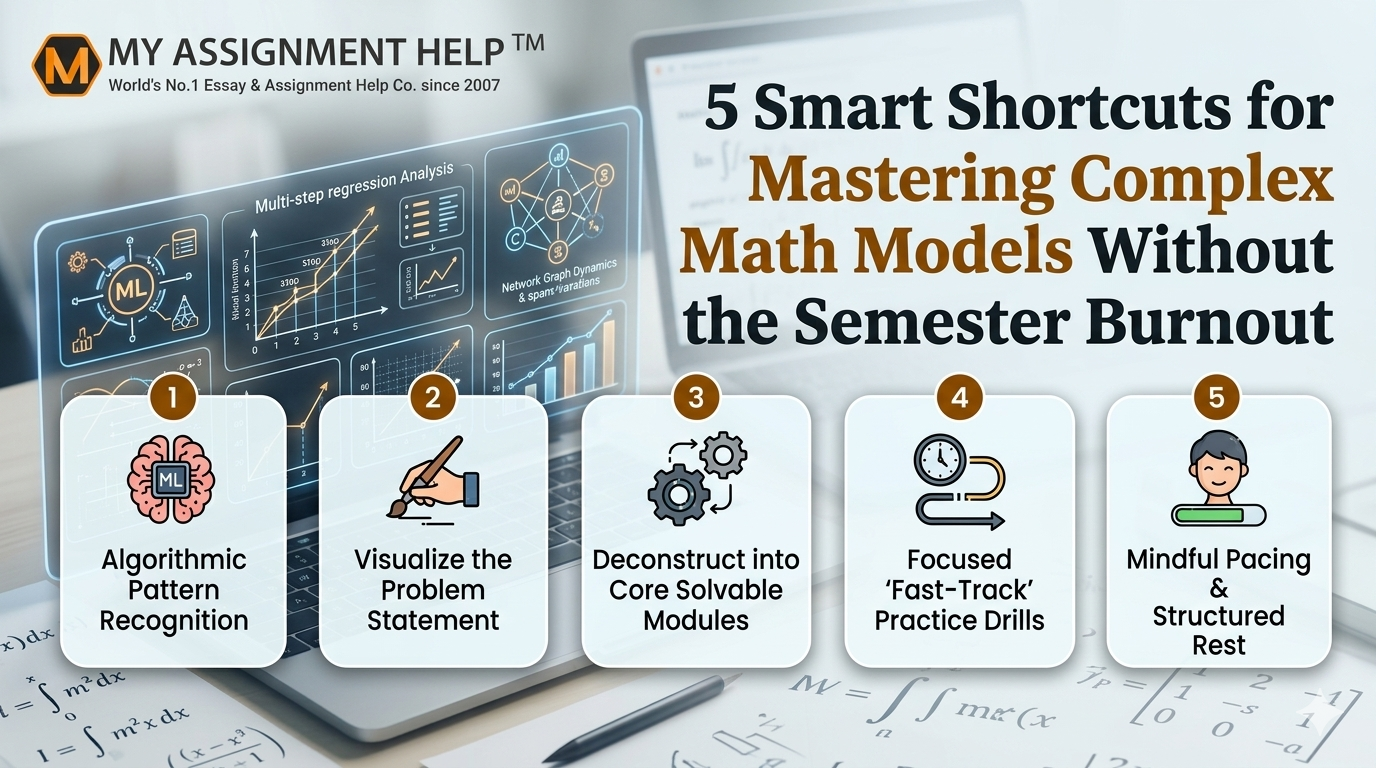
1. Leverage the “Reverse-Engineering” Method
Instead of staring at a blank page and waiting for inspiration to strike, start with a completed solution. In advanced mathematical modelling, understanding the “why” is often significantly easier when you have already seen the “how” in a finished state. Use solved case studies, previous years’ high-distinction exemplars, or open-source repositories to deconstruct how variables interact within a model.
This process reduces the “start-up friction” that often leads to procrastination. When students hit a technical wall with foundational equations—especially in linear algebra or multivariate calculus—it is common practice to seek specialized Algebra assignment help to bridge the gap. By analyzing a professional breakdown of a specific problem, you create a mental blueprint. This “scaffolding” makes the next model significantly easier to build because you are no longer guessing the structural requirements; you are applying a proven logic.
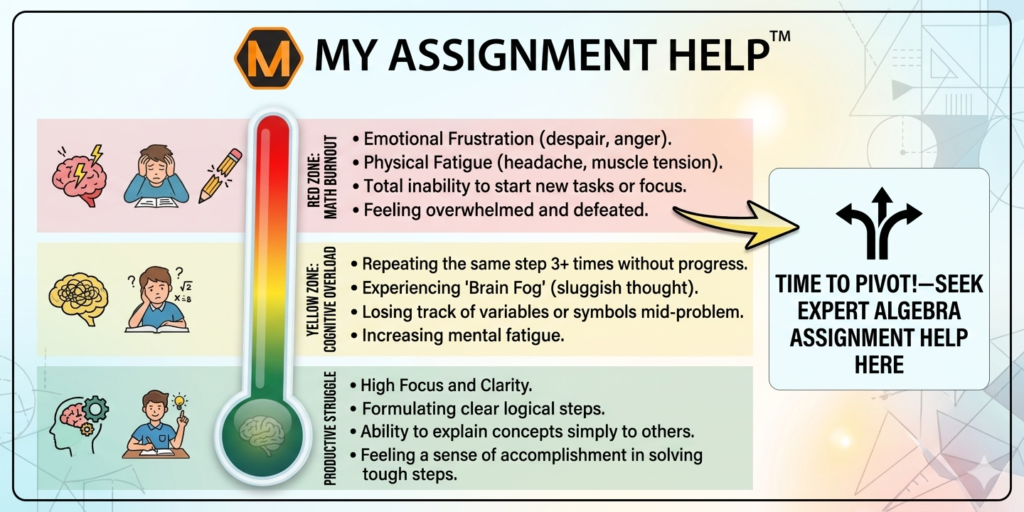
2. The Power of “Modular Learning” & Cognitive Chunking
One of the fastest ways to trigger burnout is attempting to master a 40-page stochastic model or a complex fluid dynamics simulation in one sitting. The human brain is not designed to hold that many moving parts at once. Instead, utilize “Modular Learning.” Break every model down into four constituent quadrants: the underlying assumptions, the independent variables, the operational constraints, and the expected output.
In the Australian university system, where units are designed to be cumulative, mastering one module before moving to the next prevents the “snowball effect” of confusion. If you don’t understand the constraints of a model in week three, you will be utterly lost by the time you reach sensitivity analysis in week seven. By “chunking” the information, you keep your cognitive load within a manageable range, allowing for deeper retention and less mental fatigue.
3. Use Computational Visualisation Tools for Intuition
Mathematics in 2026 is no longer a purely “pen and paper” discipline. Modern Australian curricula emphasize the use of MATLAB, WolframAlpha, and Python-based libraries like NumPy and SciPy. These tools should not just be used to find the final answer; they should be used to build intuition.
Computational visualization allows you to see how changing a single variable affects the entire model’s trajectory in real-time. Seeing a 3D plot shift or a bell curve flatten provides an intuitive understanding that a static textbook or a black-and-white lecture slide cannot offer. However, the learning curve for these software packages can be steep. If you find yourself overwhelmed by the technicality of the code while juggling three other mid-semester exams, it is a strategic move to ask a professional to do my assignment. This allows you to focus on the high-level conceptual understanding and the “big picture” analysis rather than getting bogged down in the syntax of a coding language.
4. Apply the “Feynman Technique” for Math Mastery
To truly master a model, you must be able to explain it to someone who has no background in the subject. This is known as the Feynman Technique. If you cannot explain a linear regression model or a second-order differential equation in simple, non-technical terms, you haven’t mastered the concept—you’ve simply memorized the steps.
This technique is a “burnout-killer” because it identifies exactly where your knowledge gaps are. When you stumble over a definition or cannot explain why a certain variable is treated as a constant, that is the exact point where your brain is wasting energy. By smoothing out these gaps through simple explanation, you make the mental retrieval of that information much faster and less taxing during an exam.
5. Strategic Resource Allocation and Outsourcing
Australian students often fall into the trap of “rugged individualism,” believing they must solve every problem in isolation. However, the most successful students at Group of Eight (Go8) universities view their degree like a business project. They utilize academic support services as a strategic resource.
Think of it as a “consultancy” for your academic career. Outsourcing the heavy lifting of formatting, checking for referencing errors (such as AGLC4 for law-math hybrids or APA 7th), and initial drafting allows you to spend your limited “brain-power” on the sections that carry the most marks: the analysis and the conclusion. This strategic allocation of effort ensures that you maintain a high GPA without sacrificing your mental health.
See also: 6908943703 Trends Explained Today by Mitchnews Com
Key Takeaways for the 2026 Semester
- Deconstruct Early: Don’t wait for the deadline. Use solved examples to see the logic before you attempt the assignment.
- Visualise the Data: Use Python or MATLAB to turn abstract numbers into visible shapes to build your “gut feeling” for math.
- Modularise Your Study: Spend 50 minutes on one specific “chunk” of a model, then step away. Avoid the “marathon” study sessions that lead to errors.
- The 10-Year-Old Rule: If you can’t explain your math assignment to a 10-year-old, you don’t understand the logic well enough yet.
- Leverage Support: Treat academic services as a partner in your success, not a last resort.
Frequently Asked Questions (FAQ)
Q1: Is math burnout different from general academic burnout?
A: Yes. Math burnout often involves “cognitive blocking,” where the brain physically struggles to process numerical logic due to high cortisol levels caused by “math anxiety.”
Q2: How do professional services help with math assignments specifically?
A: They provide step-by-step derivations and logic chains. This helps students see the intermediate steps that are often skipped in fast-paced university lectures.
Q3: What are the most common math models used in Australian Business degrees?
A: Linear Programming, Time-Series Analysis, and Monte Carlo Simulations are currently the most prevalent models in 2026.
Q4: Can I use AI to solve these models?
A: While AI can assist, Australian universities use advanced detection for logic patterns. Using a human-led service ensures that the mathematical reasoning is sound and plagiarism-free.
Author Bio
Dr. Sarah Jennings is a Senior Content Strategist and Academic Consultant at MyAssignmentHelp. With a PhD in Applied Mathematics and over a decade of experience in the Australian higher education sector, Sarah has helped thousands of students at institutions like Monash and UQ overcome “math phobia.” She is a frequent contributor to EdTech journals and a passionate advocate for student mental health in STEM.
Data Sources and References
- Tertiary Education Quality and Standards Agency (TEQSA) 2025: Annual Report on Student Academic Progress and Support.
- Australian Bureau of Statistics (ABS): Education and Work, Australia – 2025/2026 STEM Trends.
- Journal of Mathematical Psychology: The Impact of Visualisation Tools on Cognitive Load in Tertiary Students (2026).
- University of New South Wales (UNSW): Student Wellbeing and Mathematics Achievement Study.